Abstract This paper advances the conceptual framework introduced in “The Emergent Frame,” refining its ontological commitments and clarifying the role of fundamental constructs in physical theory. By stripping down physics to its most essential layers — matter and space — we challenge prevailing assumptions about fields, spacetime, and the structure of physical inquiry. This revised framework brings classical insights, such as Einstein’s mass-energy relation, into harmony with a more relational and emergent worldview. The goal is to sharpen the foundational language of physics while preserving empirical adequacy and philosophical coherence.
Reconsidering the Ontology of Fields
In the original formulation of the emergent frame, we positioned fields as the ontological substrate from which both matter and spacetime arise. Here, we further clarify that these fields should not be conflated with traditional constructs like electromagnetic, gravitational, or Yang-Mills fields — each of which is defined over an assumed background spacetime. Instead, we propose a more radical view: these fundamental fields are not defined in space, but rather constitute the precondition for the emergence of space itself. They do not propagate in spacetime but give rise to it when localized, self-sustaining excitations — what we term “nodal condensations” — occur. This reframing shifts fields from being elements of the universe to the very medium that permits any universe to manifest.
From Spacetime to Space as the Foundational Construct
Building on this ontological refinement, we now revisit the status of spacetime. While physics since Einstein has emphasized a unified four-dimensional continuum, our view suggests that this continuum can and should be decomposed. In particular, we argue that space — understood as the relational pattern emerging between nodal condensations — is the primary emergent structure. Time, in this picture, is not fundamental, but a derived ordering among changes in spatial configurations. This aligns well with the semantic root of the word “space” in many natural languages, especially the Chinese concept of “kongjian”, meaning “the emptiness between things.” Such an interpretation invites us to simplify our theoretical ontology: it is not spacetime we must explain, but how space arises when matter structures are present.
Revisiting Einstein’s Mass-Energy Equivalence
This minimalist framework does not dismiss the achievements of 20th-century physics but offers them new meaning. Einstein’s celebrated equation, E = mc² , becomes more than a numerical equivalence. Within our model, it reflects a profound structural principle: the energy of a nodal condensation is determined by its stability and coherence within the field, modulated by the invariant rhythm of spatial propagation — embodied in the speed of light. In other words, energy is not a stored substance but a measure of how strongly a node resonates with the underlying field and participates in the expansion of space. Thus, Einstein’s relation serves as a conceptual bridge between the structural formation of matter and the kinematics of emergent space.
Applying Occam’s Razor to Physical Theory
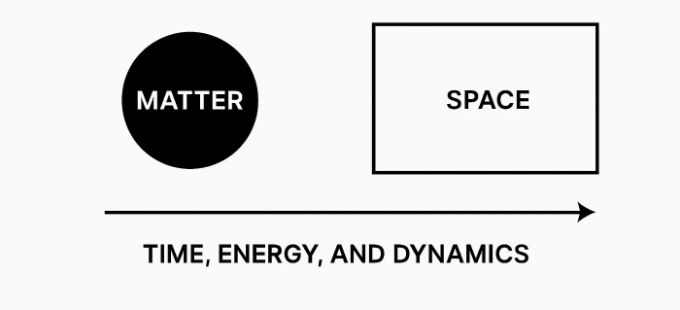
Given the epistemological economy desired in scientific modeling, we invoke Occam’s Razor to streamline our ontological commitments. If a proposed layer — such as a pre-spatial field background (metaphorically dubbed the “God layer”) — cannot be observed, interacted with, or falsified, it should not form part of the physical theory’s operative structure. We retain only two categories of fundamental objects: matter, as localized nodal structures, and space, as the relational geometry that arises among them. Time, energy, and even force are understood not as ontological primitives but as emergent descriptors of changing spatial relations among nodal structures.
Rethinking the Classification of Physical Phenomena
This ontological revision also invites a reassessment of how we classify physical domains. Conventionally, phenomena are sorted by scale: small implies quantum, large implies classical or relativistic. We argue instead for a categorization based on ontological layer. For example, quantum entanglement should not be seen as merely a microscopic effect, but as an indication of unresolved coherence within field-level structures. Similarly, confinement in strong interactions arises not from distance scales but from structural constraints on nodal formation. This approach enables a more principled integration of quantum, classical, and gravitational phenomena within a common relational grammar.
Conclusion
In refining the emergent frame, we advocate for a leaner and more precise ontology of physics. Fields, though not directly observable, remain implicit as the prerequisite for all structure. Matter and space, in contrast, form the operational foundation of our models. Time, energy, and dynamics emerge from their interactions. This approach honors both empirical adequacy and philosophical clarity. Future work will address more detailed models of nodal geometry and rhythm, potentially incorporating the rotational or helical forms alluded to in earlier discussions. For now, the goal is clear: to build physical theory not on metaphysical speculation, but on the bare relations that render a world visible at all.