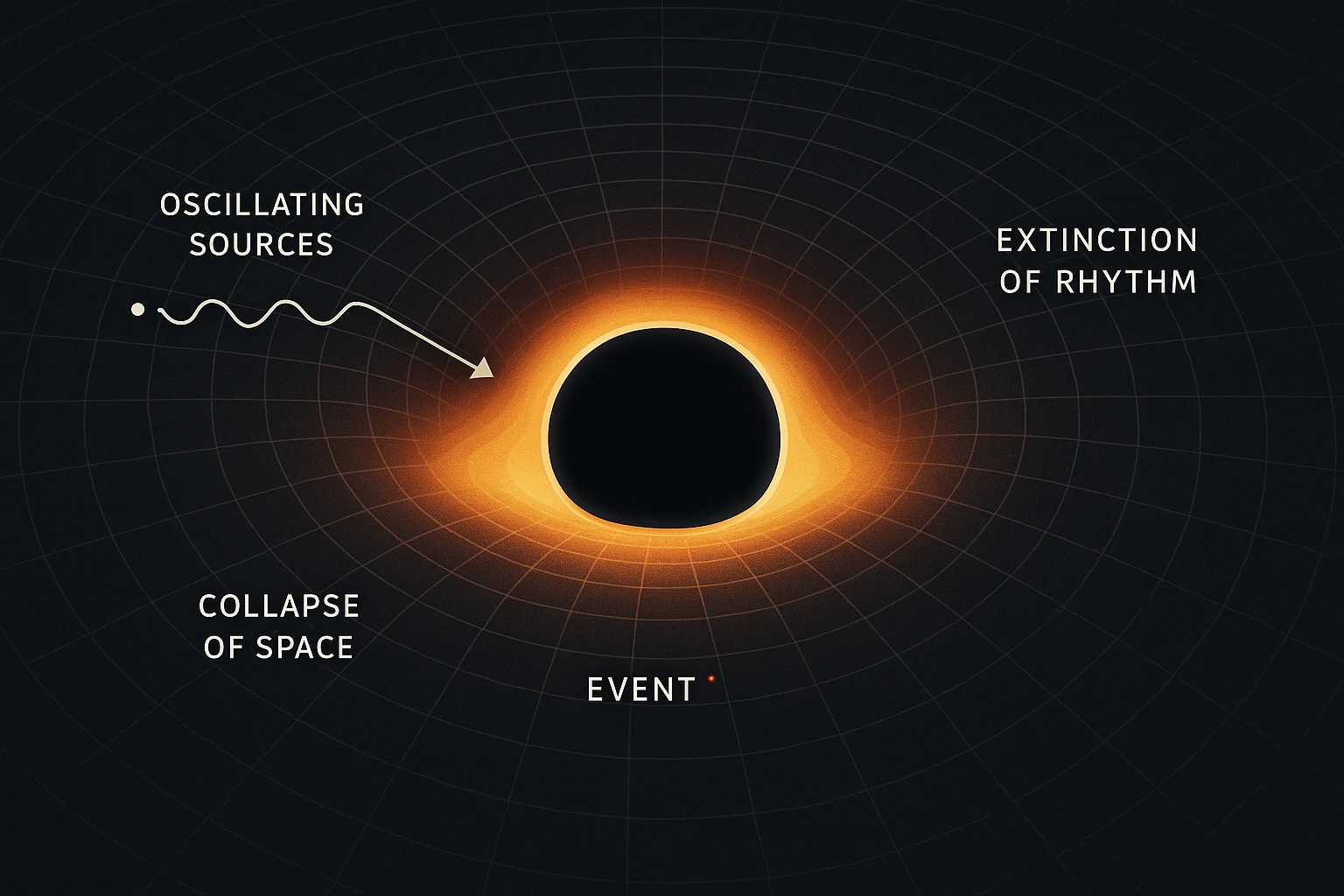
In the framework of The Emergent Frame (TEF), where space is not a pre-existing backdrop but an emergent structure woven from rhythmic relationships between material entities, the concept of a black hole takes on a radically new interpretation. Rather than viewing black holes as regions of extreme curvature within a geometric spacetime, TEF interprets them as collapsed rhythm zones: regions where the capacity for space to emerge has failed.
1. The Surface Illusion: Black Holes as Rhythmic Boundaries
To external observers, a black hole presents a spatial boundary: the event horizon. It seems to have a volume, an area, a gravitational influence. But these properties arise not from the internal structure of the black hole, but from the way external rhythm fields are deformed or terminated by the presence of the collapsed region.
In TEF, the event horizon is not a boundary in space, but a limit of rhythm propagation: a zone beyond which rhythmic structure cannot stably unfold into emergent space. This produces the illusion of a boundary and volume, even though no space exists beyond it in the conventional sense.
2. Inside the Horizon: Space Extinguishes
Beyond the event horizon, no observer maintains a coherent frame to describe spatial unfolding. In TEF terms:
Space is not compressed — it is no longer generated.
Distance, direction, and location are not “extreme” — they are undefined. The rhythmic structures necessary to maintain spacetime geometry break down, collapsing into a singularity not of infinite density, but of zero spatial differentiation.
This is why we propose that from a TEF perspective, the singularity is not a “point in space” but the complete deactivation of spatial rhythm — a pure frequency node, stripped of phase relations and unable to sustain extension.
3. Black Holes as Rhythm Sinks
TEF redefines black holes not as wells in a pre-existing geometry, but as rhythm sinks: regions where local rhythmic structure becomes too dense, too incoherent, or too divergent to support stable spatial interference. This threshold manifests at the event horizon.
Once inside, rhythm decouples from space. Propagation halts. The internal structure becomes a sealed informational state — a memory with no external continuation.
4. The Apparent Volume: Tension in the Rhythm Field
So why do we see black holes as having size, shadow, and even a gravitational lens?
Because the external rhythm field must “bend” around a collapsed region, producing distortions analogous to mass in General Relativity — but fundamentally, these are phase tensions in the emergent fabric, not curvature in a fixed space.
Thus, the volume of a black hole is an external optical illusion — a mapping of rhythmic interruption, not internal content.
Final Thought
In The Emergent Frame, the black hole is not a place — it is the absence of place, the quenching of space by rhythm collapse. It reveals that the space we take for granted is not a void to be filled, but a living mesh of structured difference — one that can be extinguished.
The black hole, then, is the moment that space forgets how to unfold.