Abstract: This paper proposes a unified conceptual framework that regards fields as the ontological substrate of physical reality, wherein matter arises as localized, self-sustaining excitations (“nodal condensations”) of these fields. In contrast to classical interpretations where spacetime is treated as a fixed backdrop for physical phenomena, we argue that spacetime is an emergent, relational structure arising from the presence and dynamics of matter. Time and space are thus not fundamental entities but byproducts of field interactions, manifesting only when localized excitations occur. Moreover, we explore the hypothesis that spacetime propagation — both as causal structure and gravitational wave geometry — occurs at the invariant speed of light, making light speed not merely a speed limit, but the foundational rhythm by which spacetime itself unfolds.
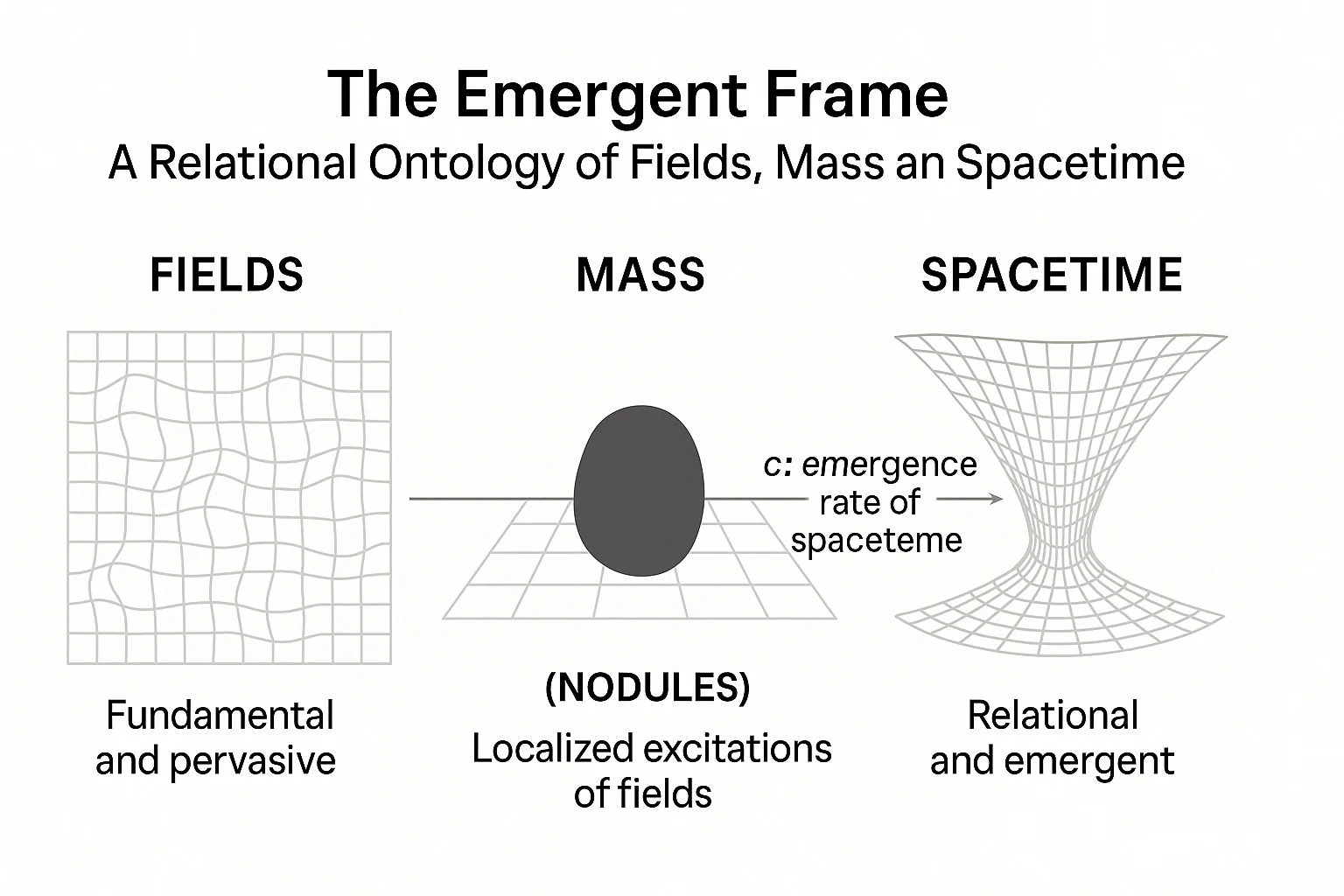
1. Introduction The distinction between matter and energy, and between space and time as containers versus participants, has been profoundly challenged by developments in quantum field theory and general relativity. Traditionally, matter has been associated with particles and mass, and spacetime with the inert container of events. Yet, if particles are merely quantized excitations of fundamental fields, and if spacetime curvature is determined by energy-momentum distributions, then both matter and spacetime lose their classical independence and reveal a deeper, unified structure.
2. Matter as Field Condensations Quantum field theory tells us that all particles are excitations of underlying quantum fields. An electron is not a point-like object, but a stable excitation of the electron field. Extending this idea, we view what we call “matter” as localized, stable knots or condensations of energy in a field — spatially bound resonances that maintain coherence. These condensations represent the only places where spacetime metrics become meaningful, as they provide reference frames, causal trajectories, and interaction points.
3. The Relational Emergence of Spacetime In a universe devoid of any field excitations — i.e., without matter or energy perturbations — spacetime, as we understand it, loses operational meaning. In our framework, spacetime is not a prior condition for fields to act within, but a relational structure that emerges from the presence and interaction of field excitations. Distance becomes meaningful only as the relation between nodes; time is the interval marked by changes in field configurations.
4. Light Speed as the Generator of Spacetime Texture The speed of light, traditionally treated as a universal velocity cap, is reinterpreted here as the propagation rate of causal and metric information through the field structure. Spacetime changes — whether in the form of causal signaling, particle interactions, or gravitational wave propagation — are all constrained to unfold at light speed. Thus, the “speed of light” is not merely a constraint within spacetime, but a measure of the emergence rate of spacetime itself.
5. Implications and Analogies This framework harmonizes with background-independent theories such as loop quantum gravity and hints at deeper resonances with relational quantum mechanics and information-theoretic approaches. Just as a ripple cannot exist without a medium, a spacetime interval cannot exist without field excitation. Matter draws the canvas of spacetime behind it.
6. Conclusion By recasting matter as structured field condensations and spacetime as their relational scaffolding, we unify what have long been treated as separate ontological categories. Time and space do not preexist interaction; they crystallize through it. Light speed becomes the metronome of reality’s unfolding. This view not only aligns with but deepens modern physical theory, potentially guiding future formulations in quantum gravity, field theory, and the nature of emergence itself.
This paper emerged as a result of a dialogue between the author and ChatGPT, with the AI assisting in the structuring, refinement, and expression of the core ideas discussed.