Glueballs — bound states made only of gluonic interaction — suggest that “forces” can stabilize into particle-like entities. From the Emergent Frame (TEF) viewpoint, this flips the usual hierarchy: particles, fields and even space-time are not fundamental objects but enduring patterns within a deeper web of quantum relationships.
For a long time, human beings have imagined the universe as a collection of objects.
Things exist.
Things occupy space.
Things interact through forces.
A stone has mass. An electron has charge. A force acts between objects and changes their motion.
This picture was remarkably successful. Newtonian mechanics described the macroscopic world with extraordinary precision.
But as we entered the quantum realm, this intuitive picture gradually began to change.
Particles were no longer tiny solid objects.
The deeper we looked, the more we found that what we call “objects” might actually be stable patterns of something more fundamental.
The possible existence of glueballs provides one of the most fascinating examples of this idea.
Beyond Objects and Forces
In classical physics, a force is something acting between objects. But at the quantum scale, the word “force” becomes a convenient description of something much more subtle. Electromagnetic interaction, weak interaction, and strong interaction are not simply invisible pushes and pulls. They describe how quantum states influence each other. A particle’s charge, spin, and other properties determine how it can interact with other quantum structures.
In modern physics, we often describe these interactions through quantum fields and exchange particles. This framework works extraordinarily well.
But it leaves open a deeper question:
Are fields and forces fundamental realities, or are they descriptions of deeper relationships?
The Strange Case of Glueballs
The strong interaction is particularly interesting. Unlike photons, which do not carry electric charge, gluons — the carriers of the strong interaction — themselves carry the property associated with the strong force.
As a result, gluons can interact with each other.
The interaction is no longer merely a connection between particles. The relationship itself becomes dynamic. Under certain conditions, these quantum interactions can form a stable bound structure composed primarily of gluonic energy — a state known as a glueball.
Experiments such as those conducted with the Beijing Spectrometer III (BESIII) have provided important evidence for glueball candidates, although the precise identification of a pure glueball remains an active field of research.
The deeper significance is not simply that another particle exists.
It is that nature appears to allow:
A stable pattern of interaction to behave like an independent physical entity.
When Relationships Become Things
A traditional hierarchy looks like this:
Objects
   ↓
Interactions between objects
   ↓
Forces
But quantum physics suggests another possibility:
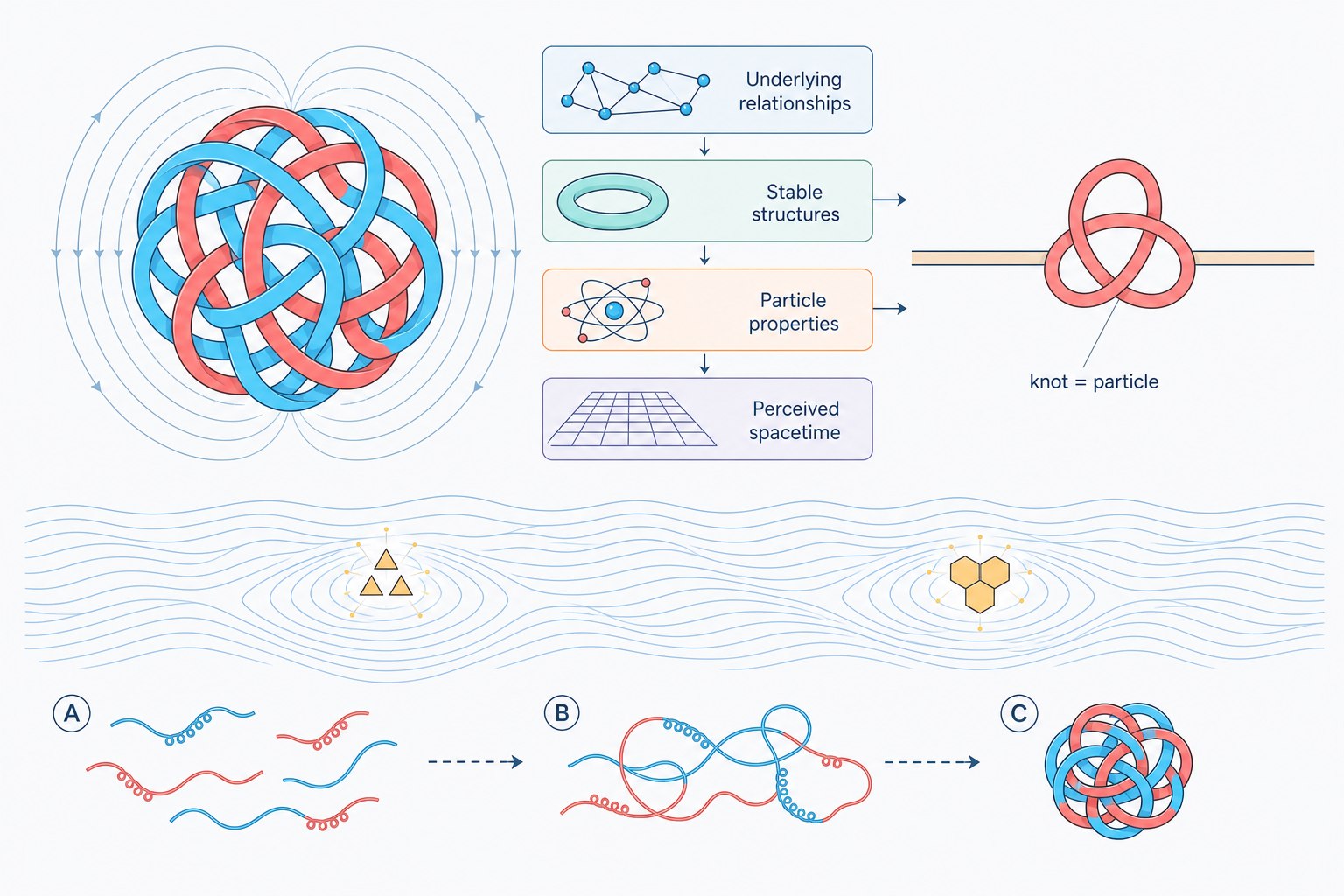
Underlying relationships
   ↓
Stable structures
   ↓
Objects and observable properties
The distinction between “thing” and “relationship” may not be fundamental. A wave is not a separate substance from the ocean. A vortex is not an additional material added to water. They are stable patterns of motion. Yet they are real.
Similarly, a particle may not necessarily be a tiny object carrying intrinsic properties. It may be a stable configuration of deeper relationships.
A Different Perspective on Matter
The existence of glueballs inspires a broader question: What makes something a particle? Is a particle a fundamental object that exists first, and then interacts? Or is a particle a persistent structure that emerges from the interaction itself?
The second possibility does not contradict modern physics. It simply changes the perspective. Mass, charge, spin, and other properties may not be labels attached to independent objects. They may be characteristics of stable structures. A particle is not something placed into the universe. A particle may be something the universe organizes.
The Emergent Frame: From Structures to Spacetime
The Emergent Frame (TEF) explores an even deeper possibility. Perhaps not only particles, but also space and time are emergent.
The conventional picture is:
Spacetime
     ↓
Matter exists inside spacetime
     ↓
Matter interacts through forces
TEF considers another direction:
Fundamental relationships
     ↓
Stable structures emerge
     ↓
Matter appears
     ↓
Spacetime relationships emerge around these structures
In this view, space is not merely an empty container. Distance is not necessarily a primitive fact. The relationships between structures may be the deeper reality, while space becomes the language we use to describe those relationships.
A Quantum Knot in Reality
One way to imagine this is through the idea of a knot. A knot is not a new substance added to a rope. It is a special configuration of the rope itself. The existence of the knot depends entirely on relationships between different parts of the rope. Yet once formed, it has its own identity.
Perhaps elementary particles are similar. They are not independent “things” floating in space. They are stable knots in the deeper structure of reality. A glueball may represent one such possibility: A knot formed not from ordinary matter, but from quantum interaction itself.
The Universe May Be Built From Relationships
The lesson from glueballs is not that forces magically transform into matter. The deeper lesson is more subtle: The categories we use — particles, fields, forces, and spacetime — may represent different levels of description of the same underlying reality.
At one level, we see particles.
At another, we describe fields.
At a deeper level, we may find relationships and structures.
The universe may not be fundamentally made of things.
Things may be what stable relationships look like.
The Emergent Frame — Exploring the possibility that matter, space, and time are not the starting points of reality, but emergent expressions of deeper structures.