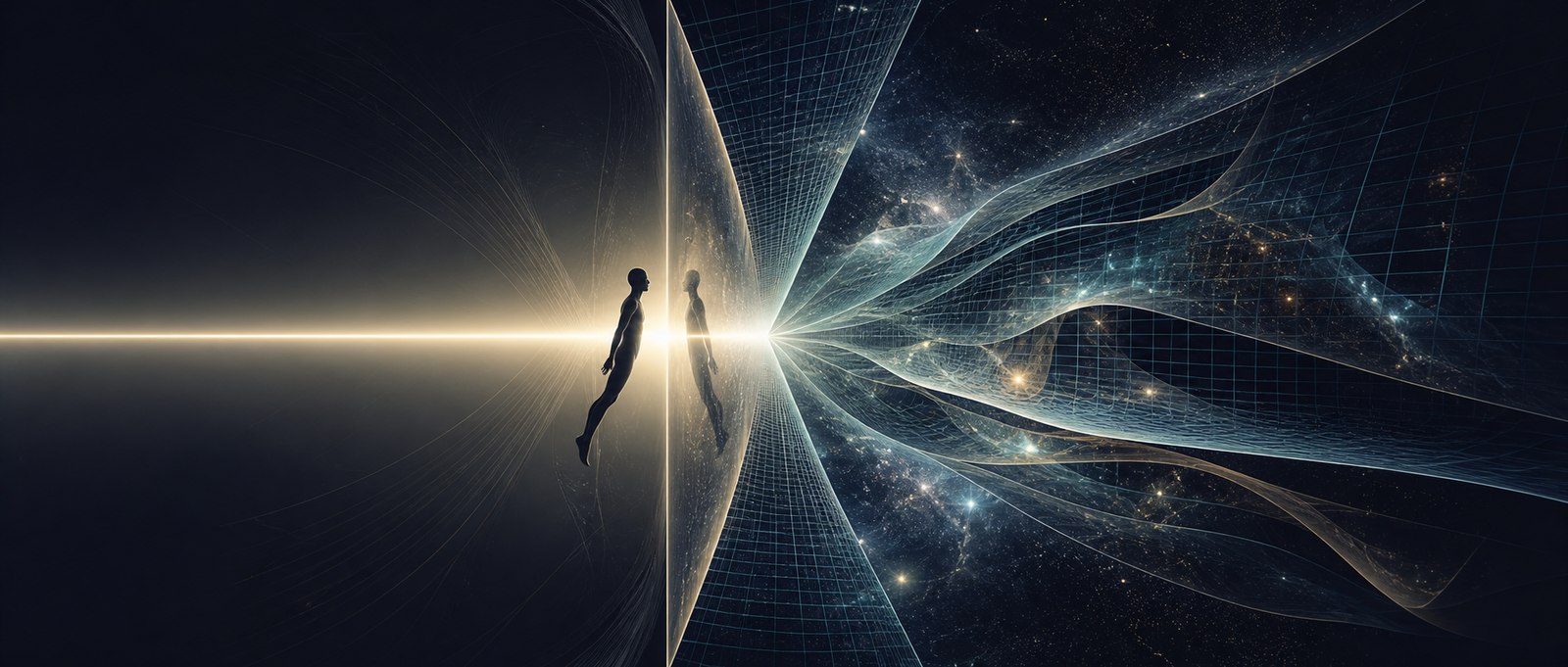
Imagine that you are sitting inside a spacecraft traveling at the speed of light.
You are on an interstellar journey. The stars are stretched into strange patterns. The universe lies ahead of you, vast and silent. Then, in this impossible cabin, you raise a mirror and try to look at yourself.
Can you see your own reflection?
At first, this sounds like a question about light. Will the light from your face reach the mirror? Will it bounce back to your eyes? If the spacecraft is already moving at the speed of light, can light still move forward inside it?
This is the classic trap.
The deeper question is not whether light can catch up with the mirror. The deeper question is whether there is still an internal moment in which “raising a mirror” can happen at all.
According to special relativity, a massive object cannot truly reach the speed of light. But a thought experiment does not have to begin with engineering feasibility. It only needs to expose the logic hidden inside our assumptions.
So let us approach the limit.
As the spacecraft moves closer and closer to the speed of light, its proper time — the time experienced by the traveler inside — slows relative to an outside observer. In the limit of light speed, the traveler’s proper time tends toward zero.
From the outside, one may describe a journey across space. One may speak of distance, duration, acceleration, departure, and arrival. But from the traveler’s own side, the interval between entering the light-speed state and leaving it contains no experienced duration.
There is no waiting.
There is no sitting.
There is no “during the trip.”
And therefore, there is no moment in which the traveler can raise a mirror and look.
The answer is not: “You cannot see yourself because the mirror fails.”
The answer is stranger:
You do not experience the act of looking.
This simple thought experiment opens a crack in one of our deepest assumptions. We usually imagine that space and time are already there, like a vast stage, and that matter merely moves across it. The universe is treated as a container. Objects are placed inside it. Events occur within it.
But perhaps this picture is backwards.
Perhaps space and time are not merely the background of existence. Perhaps they are themselves forms of existence.
Matter does not simply occupy spacetime. Matter may be one of the ways spacetime becomes unfolded.
For massive beings like us, the universe appears as an extended field. Stars are distant. Galaxies are remote. Journeys require time. To move from here to there is to traverse a measurable interval. Our bodies, our clocks, and our experiences all participate in this unfolding. Space opens before us because our mode of existence gives rise to distance, duration, sequence, and motion.
But light tells a different story.
For us, light from a distant galaxy may have traveled for billions of years. We say it crossed an immense cosmic distance. We imagine a long journey through the dark.
Yet along a lightlike path, proper time does not pass. Light does not experience a billion-year voyage. It does not grow old on the way. It does not sit inside the universe, waiting to arrive.
To us, the universe is vast.
To light, the farthest shore is already near.
This does not mean that light has a human-like point of view. Strictly speaking, light does not possess a rest frame. But the boundary revealed by light is profound. It suggests that distance and duration are not absolute substances. They are relational structures, emerging from the way existence is unfolded.
What we call “far away” may be a feature of massive existence.
What we call “time passing” may be the internal rhythm of a particular mode of being.
This is one of the starting intuitions behind The Emergent Frame.
TEF begins with the suspicion that spacetime is not a pre-existing container shared equally by all things. Instead, spacetime may be emergent, local, and mode-dependent. Each form of existence participates in its own way of unfolding the world.
A massive object rolls out time and space. It carries a clock not merely as a device, but as an expression of its own structure. Its world has thickness, sequence, and duration. Its events do not simply happen “in time”; rather, time is part of how those events become real.
Light, by contrast, marks a boundary. It is not merely a fast object moving through space. It is a limiting form of connection. It links events without possessing the same temporal thickness that massive beings experience. It is less like a traveler crossing a road and more like an axial relation inside the structure of unfolding.
This is why the mirror thought experiment matters.
It does not merely tell us that light speed is unreachable. It tells us that experience itself depends on proper time. Without proper time, there is no interior sequence. Without interior sequence, there is no action. Without action, there is no observation.
The observer is not floating inside a ready-made universe.
The observer is part of the universe’s own unfolding.
The mirror does not fail because the physics of reflection breaks down. The mirror disappears as a meaningful question because the stage on which “looking into a mirror” could occur has collapsed to zero duration.
This forces us to ask:
What is space, if its vastness depends on the mode of existence that unfolds it?
What is time, if its flow belongs to the structure of the being that experiences it?
What is matter, if it is not merely something inside spacetime, but one way in which spacetime appears?
The traditional picture says:
First, there is spacetime.
Then, matter moves within it.
The Emergent Frame suggests another possibility:
First, there is existence.
Matter, time, and space are different ways in which existence becomes articulated.
From the human scale, the universe is immense. We live inside distance. We age inside duration. We measure the stars because our mode of being unfolds a world in which stars are far away.
But light reminds us that this vastness is not the only possible relation to the cosmos.
For massive beings, the universe is a journey.
For light, the universe is a near-touching.
Perhaps this is the first lesson:
Space is not the container of existence.
Space is one way existence opens.
Time is not the background of becoming.
Time is one way existence unfolds.
And what we call the universe may not be a single stage at all, but a field of unfolding frames — each revealing reality according to its own mode of being.