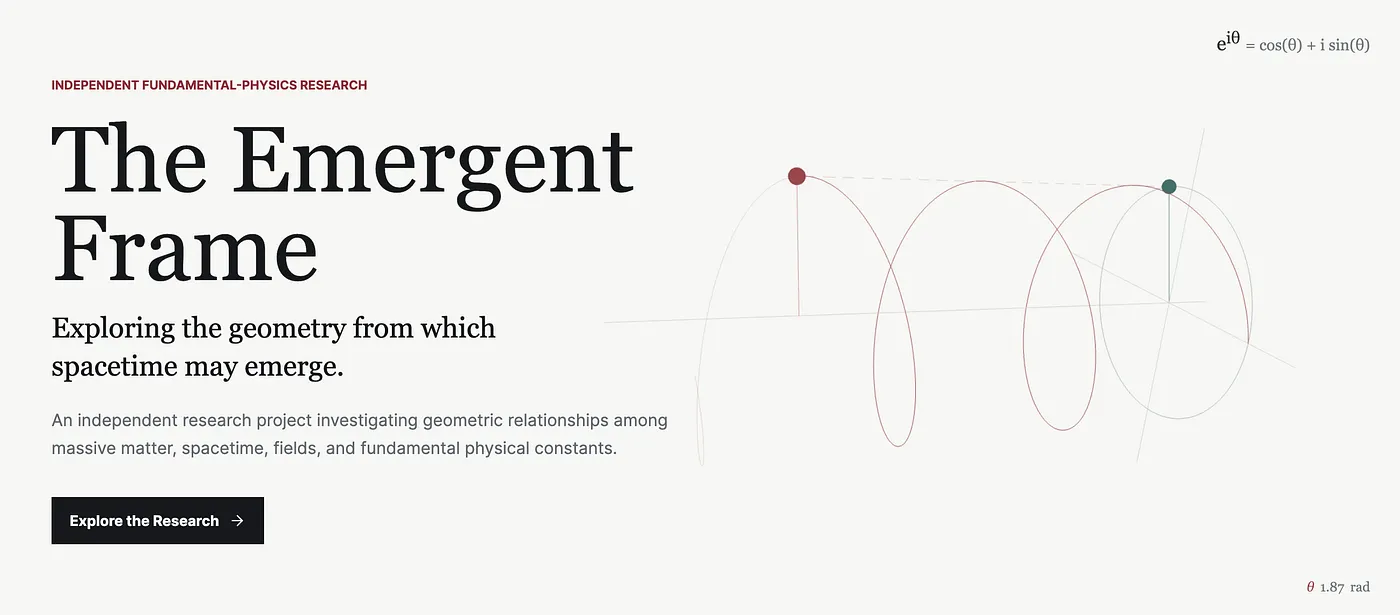
The official website of The Emergent Frame (TEF) is now live, and I have also published the first serious paper developed under this framework. For me, these two events mark the same transition: TEF is moving from a collection of private thought experiments into a public research program.
TEF began with questions that were admittedly speculative — perhaps even fanciful. What if spacetime is not simply a pre-existing stage on which matter exists? What if some properties we regard as fundamental emerge from a deeper geometric structure? Ideas like these are easy to imagine and difficult to distinguish from metaphysics. So I eventually imposed a simple rule on myself: if TEF contains anything physically meaningful, it must be expressible mathematically, and whatever it produces must remain compatible with established physics and experimental evidence.
That rule changed the nature of the project.
From playing with constants to doing research
I decided to begin with fundamental physical constants. Modern physics measures many of them with extraordinary precision, but some still enter our theories as empirical inputs rather than consequences derived from deeper principles. If TEF really describes some underlying structure, perhaps traces of that structure should appear there.
At first, this was largely exploratory. I tried geometric relationships, dimensionless ratios and different ways of connecting TEF’s assumptions with known quantities. There is an obvious danger in this kind of work: with enough constants, powers of π and mathematical freedom, one can manufacture impressive-looking numerical coincidences almost indefinitely. That is numerology, not physics.
I am particularly wary of that trap. I was trained in scientific research, and I know that an attractive interpretation is not evidence. Assumptions have to be stated clearly; equations must be dimensionally and mathematically consistent; results must be compared against established theory and experiment; alternative explanations have to be considered; and, above all, a hypothesis must expose itself to the possibility of being wrong.
But once some of the early numerical experiments began organizing themselves into a more constrained mathematical structure, I felt that the project deserved more serious treatment. The question was no longer merely whether two numbers looked surprisingly close. The interesting question became whether assumptions introduced for one reason could produce independent consequences elsewhere.
That transition eventually led to the first serious TEF paper, A Helical Spacetime Ansatz Linking the Planck Scale and Electroweak Mixing. The paper explores whether a simple geometric ansatz can connect a Planck-scale construction with the electroweak weak mixing angle.
It does not prove TEF. That is not what I think a first paper should claim to do.
Its purpose is to make part of TEF precise enough to be examined, criticized — and potentially falsified.
An old lesson about failed roads
There is a personal reason why I am comfortable proceeding this way.
More than twenty years ago, while studying at the University of Southern California, I worked with my advisor Elaine Chew on music information retrieval. We eventually published Separating Voices in Polyphonic Music: A Contig Mapping Approach. At the time, however, I felt that our results were not particularly successful. I remember asking Elaine, essentially: if the method does not really work, what is the use of publishing it?
Her answer stayed with me: even if a road does not work, showing others that this road does not work is itself useful.
I found that enormously encouraging then, and I have carried the lesson with me ever since. Science is not simply a collection of successful answers. Carefully eliminating possibilities is also progress.
Perhaps TEF’s basic assumptions are wrong. If so, I would rather discover exactly where they fail than protect them with increasingly flexible explanations. My intention is therefore to proceed one derivation at a time: formulate the assumption, derive its consequences, compare them with existing physics, and continue until either a coherent structure survives or the framework breaks.
Both outcomes are scientifically interesting to me.
Building a durable public record
Returning to research as an independent researcher after more than two decades outside the conventional academic system also raised a practical question: how should the work be made public, citable and inspectable?
An early publication route centered on arXiv and required navigating its category and endorsement process. I am grateful to Robert Monjo, author of Weak mixing angle under (U(1,3)) colored gravity (arXiv:2502.11236), for endorsing that early submission attempt. His work is directly relevant to the question of whether the weak mixing angle can emerge from a deeper geometric structure.
TEF’s current publication architecture uses Zenodo for versioned, DOI-bearing preprint records, this website for research context and status, and GitHub for source, verification materials and release history. Together, these records make the work citable and auditable while keeping a clear distinction between a public preprint and a peer-reviewed publication.
No publication platform can substitute for scientific scrutiny. If TEF is going to participate in the scientific conversation, it must accept the standards and skepticism of that conversation. Skepticism is not an obstacle to TEF. It is part of the process.
What AI changes
There is one other reason I can undertake this project now: AI has radically lowered the cost of exploratory research.
A theoretical paper involves far more work than writing prose. There is literature discovery, symbolic derivation, dimensional checking, numerical computation, comparison with experimental data, reference verification, searching for counterexamples, constructing figures, LaTeX typesetting, rewriting arguments and repeatedly testing variations when an approach fails.
When I was doing research twenty years ago, a serious paper could easily consume six months of full-time work. Today, AI can compress many of those iteration loops dramatically. A candidate relationship can be tested and discarded quickly. A mathematical derivation can be attacked from several directions. Relevant literature can be mapped much faster. Known experimental constraints can be brought into the discussion almost immediately.
This does not mean AI makes a scientific claim correct, nor does it transfer responsibility from the researcher to the machine. What it changes is the speed at which hypotheses can be generated, tested, criticized and killed.
That distinction is important. The real benefit may not be that AI produces more theories. It may be that it allows us to eliminate bad theories much faster.
Trying to stand near the front
Because of this change, I suspect the next two or three years will be an unusually exciting period for physics. We now have extraordinary experimental instruments, enormous amounts of precision data, powerful numerical methods and, suddenly, AI systems capable of assisting with mathematics, computation, literature and scientific communication at the same time.
The probability that the next fundamental breakthrough in physics happens inside TEF is, realistically, very small. There are brilliant researchers all over the world working with far deeper specialization, larger teams and vastly greater experimental resources.
But that does not discourage me.
I would like to push my own hypothesis as far as it deserves to go. I would like to understand where it works, where it fails, and why. And if physics really is approaching another period of rapid discovery, I would like to squeeze into the front rows of the crowd that is trying to understand what comes next.
That is what the launch of The Emergent Frame means to me.
The website is now public. The first serious paper is public. From here onward, the assumptions can be inspected, the mathematics can be challenged, and the framework can fail in public.
That is exactly where I want it to be.
The Emergent Frame
First TEF research paper
A Helical Spacetime Ansatz Linking the Planck Scale and Electroweak Mixing