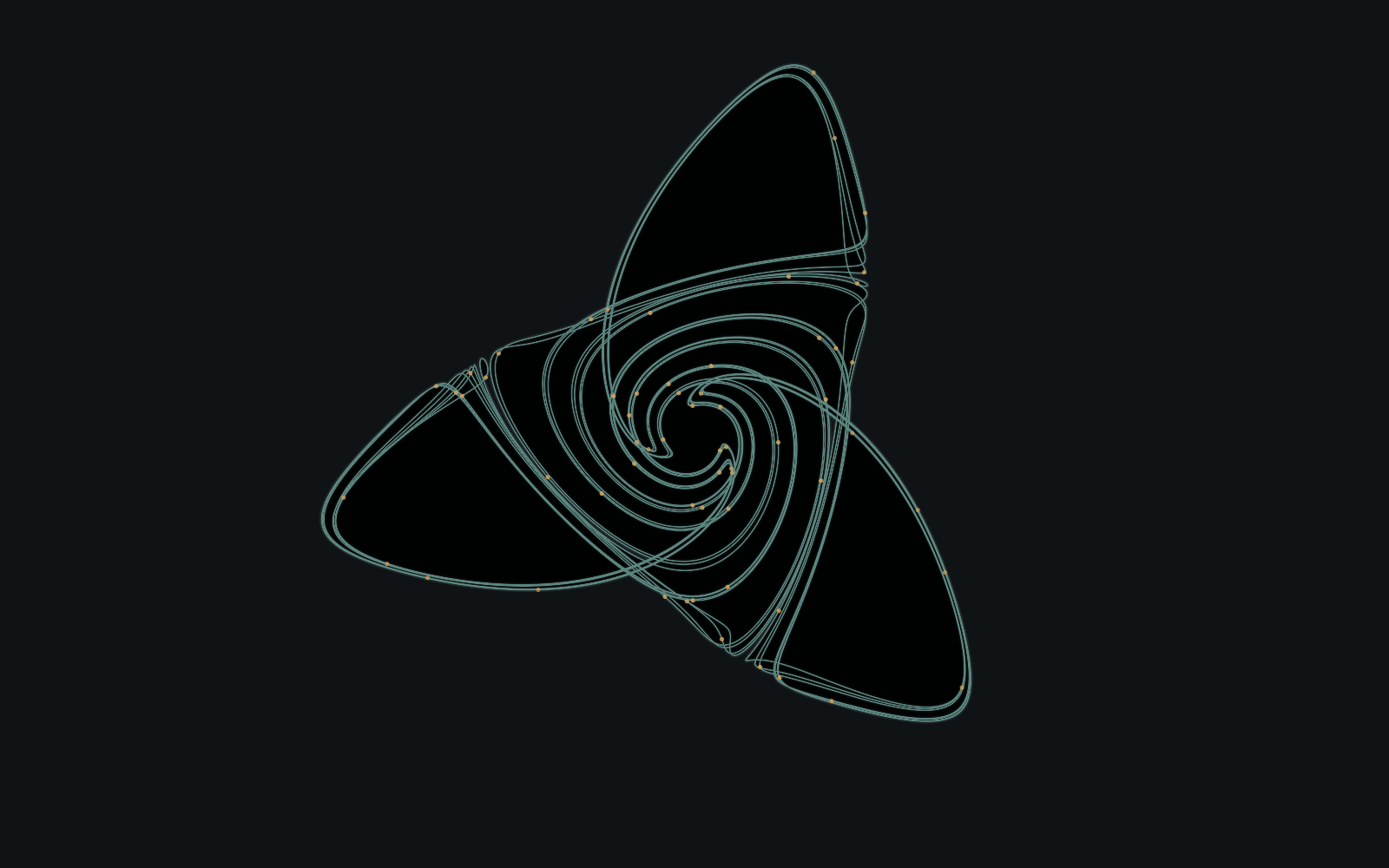
The Thomas cyclic attractor produces a flower-like trajectory from a compact three-variable system. Its visual beauty is suggestive; its cyclic operator structure provides the more precise connection to current TEF work.
A flower in state space
The image above is generated by integrating the Thomas cyclic system,
x˙y˙z˙=siny−bx,=sinz−by,=sinx−bz.Each coordinate is driven by the next coordinate in a three-step cycle and damped by the same positive parameter b. At b=0.208186, a trajectory can settle onto a bounded, intricate attractor. Viewed along the common-mode direction (1,1,1), its path develops the three-lobed form that suggested the informal name cosmic flower.
The phrase is aesthetic, not cosmological. This is a trajectory through the abstract state space (x,y,z), not the orbit of matter through physical space and not a proposed image of the universe. The interactive rendering is obtained directly from the equations with a fixed-step fourth-order Runge–Kutta integrator. Dragging changes only the viewpoint; the two controls change the damping parameter and the number of displayed samples.
What makes the system interesting for TEF is therefore not the flower metaphor. It is the cyclic operator beneath it.
Beauty from cyclic symmetry
Let the cyclic shift act as
P3xyz=yzx,P3=001100010.Then the Thomas equations can be written compactly as
x˙=sin(P3x)−bx,where the sine acts component by component. The three eigenvalues of P3 are
1,ω,ω2,ω=e2πi/3.This separates a uniform mode from two nontrivial cyclic Fourier modes. The system’s characteristic threefold organization is thus not imposed by the display. It follows from the same cyclic permutation acting at each step of the dynamics.
The attractor is also dissipative. Its phase-space divergence is constant:
∇⋅x˙=−3b.For b>0, volumes in state space contract. The persistent structure emerges from nonlinear cyclic feedback under dissipation rather than from a conservative orbit.
Where the TEF connection becomes exact
Define the discrete cyclic difference operator
D3=I−P3.Its positive semidefinite product is
D3†D3=(I−P3†)(I−P3)=3I−J,where J is the 3×3 all-ones matrix. Written explicitly,
3I−J=2−1−1−12−1−1−12.This is the Laplacian of the three-cycle. Its zero mode is the common vector (1,1,1), while the two-dimensional sum-zero subspace carries the nonzero eigenvalue 3.
That operator already appears, independently, in the symmetric-sector Gram matrix developed in Paper VI:
G3=2Λ2s2(3I−J)=2Λ2s2D3†D3.This equality is exact. It says that the same three-cycle difference geometry organizes the relevant quadratic form. It also gives a precise reason to study cyclic systems alongside the closure obstruction developed across Paper IV and Paper V.
The equality does not show that the Thomas attractor is a particle model or that its plotted trajectory is a matter configuration. The connection is at the operator level: a shared cyclic shift and its induced Laplacian.
Where the analogy stops
Several distinctions prevent the picture from being overread.
First, the visually rich attractor occurs near b≈0.208, whereas the linear operator Cb=bI−P3 acquires a common-mode zero eigenvalue at b=1. These are different parameter statements. The attractor does not generate the exact Gram-matrix identity.
Second, the Thomas system contracts phase-space volume. No TEF energy functional, conservative closure law, or physical time interpretation has been identified with this flow.
Third, the coordinates x, y, and z are state variables. Their threefold symmetry should not be identified with three spatial dimensions, color charge, quark flavors, or any other physical triplet without a derivation.
Finally, visual resemblance is not evidence. The flower is useful because it makes cyclic organization visible and raises mathematical questions. It is not support for TEF by itself.
A research direction, not a conclusion
The useful next step is to ask which parts of the three-cycle result survive beyond the picturesque N=3 case. For an N-cycle with shift PN, the Laplacian
LN=(I−PN)†(I−PN)has eigenvalues
λk=4sin2(Nπk),k=0,1,…,N−1.At N=3, the cycle graph and the complete graph happen to coincide, so both give the same nonzero spectrum. At N=4 they separate. That makes the four-sector extension a useful discriminator: it can reveal whether a proposed TEF structure genuinely comes from nearest-neighbor cyclic differences or from a more general simplex-like coupling.
A second direction is to replace the real cyclic shift with a phase-twisted operator PN(Φ). Such a construction could test whether holonomy or closure phase modifies the spectrum in a controlled way. A third is to build a closure-preserving nonlinear toy system whose conserved or dissipated quantities are explicit from the outset.
These are research questions, not conclusions. The present result is narrower: cyclic feedback can create unexpectedly rich geometry, and a precisely defined cyclic difference operator already appears in the TEF matter–space interface program.
Reproducibility and sources
The default rendering uses b=0.208186, time step Δt=0.022, 6,500 discarded warm-up steps, and 26,000 displayed steps. The initial condition is (0.1,0,0). The static fallback was generated by the same deterministic integration and projected along the common-mode axis.
The system was introduced by René Thomas in “Deterministic Chaos Seen in Terms of Feedback Circuits: Analysis, Synthesis, ‘Labyrinth Chaos’”, International Journal of Bifurcation and Chaos 9(10), 1889–1905 (1999). A concise numerical description and further references are available in J. C. Sprott’s Thomas’ cyclically symmetric attractor.
The full-resolution static figure and asset manifest preserve the numerical settings and file hashes used for this publication.