Abstract: The twin paradox is usually explained by placing both twins within a single spacetime and calculating the different amounts of proper time accumulated along their worldlines. This essay proposes a different interpretation based on The Emergent Frame, or TEF. In this framework, there is no universal spacetime shared by all matter. Every massive object rolls out its own spacetime structure and accumulates its own internal physical evolution. The traveling twin does not age more slowly relative to a cosmic clock; rather, the two twins generate unequal amounts of experienced spacetime between departure and reunion. Their age difference becomes physically comparable only when their material histories intersect again. This interpretation preserves the empirical predictions of relativity while replacing the image of matter moving through a common spacetime with one in which massive matter itself unfolds spacetime.
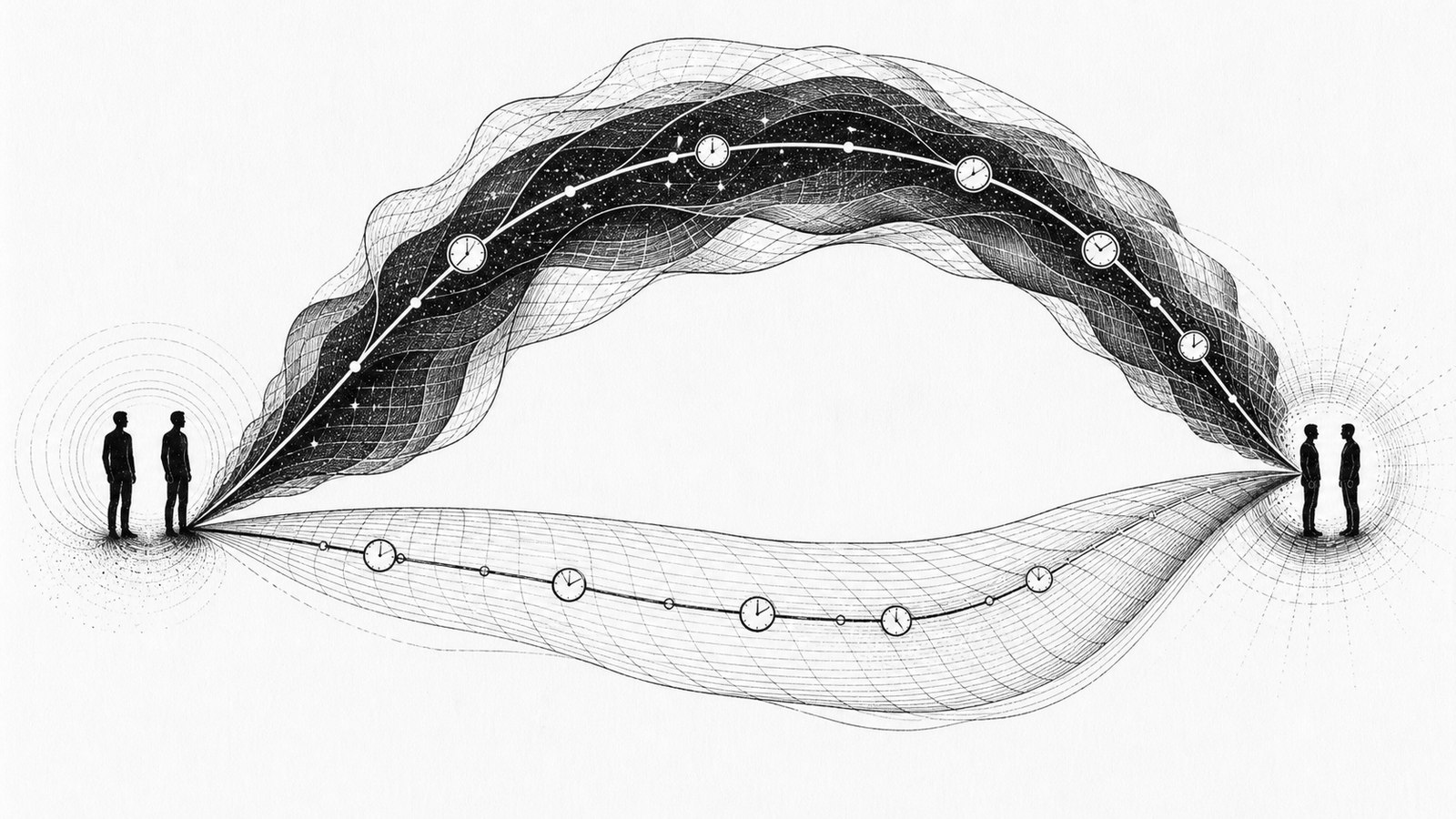
Two identical twins meet, synchronize their clocks, and then separate. One remains on Earth. The other boards a spacecraft, travels at a velocity close to the speed of light, reverses direction, and eventually returns. When they meet again, the traveling twin is younger.
This is the famous twin paradox.
Einstein’s special relativity predicts the result precisely. The two twins follow different worldlines, and the proper time accumulated along the traveler’s worldline is smaller. There is no mathematical contradiction.
Yet the usual explanation leaves behind a conceptual uneasiness.
If motion is relative, why can each twin not regard the other as the traveler? Why does one age less in an objective, experimentally measurable way? Standard accounts answer by emphasizing acceleration, changes of inertial frame, or the different geometries of the two worldlines.
These answers are correct within relativity. But they continue to rely on a deeper picture: both twins are assumed to inhabit one common spacetime.
The Emergent Frame, or TEF, begins elsewhere.
Its central proposition is that there is no universal spacetime shared by all material objects. A massive object does not merely occupy a region of spacetime. It continuously rolls out its own spacetime structure.
Mass, in this interpretation, is not only resistance to acceleration or a source of gravitational effects. It is the capacity of a stable material structure to generate and sustain its own temporal and spatial frame.
The twin paradox then takes on a different meaning.
Two clocks, two temporal structures
A clock is usually imagined as an instrument that measures an external entity called time. But no clock directly measures a universal flow. It counts changes occurring within its own physical structure. An atomic clock counts transitions between atomic states. A biological organism accumulates metabolic cycles, chemical reactions, cellular changes, and neural activity. A radioactive sample counts decay events. In every case, time is operationally expressed as internal physical evolution.
For a massive object A, let its accumulated time be denoted by τA. For another massive object B, let its time be τB.
The conventional temptation is to imagine that both are drawing their time from a deeper universal reservoir t. TEF rejects that reservoir.
There is no cosmic clock from which different objects receive faster or slower portions. Each massive object unfolds its own temporal structure through its own physical evolution. Thus, during the journey, the twins do not move through the same time at different rates. They each continue within their own spacetime structure. The physically meaningful comparison is made only when they interact locally — first at departure and again at reunion.
At the second meeting, their accumulated internal changes differ:
Δτ(traveler) < Δτ(Earth)
This inequality does not mean that one twin failed to keep pace with an independently existing universal time. It means that the two material systems completed different amounts of physical evolution between the same two encounters.
The traveler underwent fewer atomic oscillations, fewer metabolic processes, and less biological aging. Nothing “slowed down” from the traveler’s own point of view. Every local process remained mutually consistent. The traveler’s heartbeat, thoughts, clock, and chemistry all developed normally relative to one another. Slowness appears only when two independently accumulated temporal histories are compared.
The symmetry that never existed
The apparent paradox arises from treating relative velocity as the whole physical story. During uniform separation, each twin may indeed describe the other as moving. This part is symmetrical. But the complete histories are not symmetrical. The traveling twin departs, changes motion, reverses direction, and returns. The Earth twin follows a different sequence of physical relations. The two systems do not merely possess different velocities; they undergo different histories of interaction, acceleration, and relational change.
In standard relativity, these are different worldlines through spacetime.
In TEF, the worldline is not a path traced through a pre-existing four-dimensional arena. It is a mathematical reconstruction of how a massive object’s own frame evolves relative to other massive objects.
The distinction is subtle but fundamental.
Standard language says:
The twins move along different paths through spacetime and therefore accumulate different proper times.
TEF says:
The twins unfold distinct spacetime structures, and those structures accumulate different amounts of internal physical evolution before they intersect again.
The observed result is the same. The ontology is different.
Why mass matters
TEF assigns a special role to massive matter. A massive object has a rest frame. It can carry a physical clock, maintain internal cycles, and accumulate nonzero proper time. Its existence has temporal depth: it can undergo a sequence of internal states while remaining identifiable as the same material system. In TEF terminology, this is what allows it to roll out a spacetime structure.
Light is different.
A photon does not possess a rest frame, and along a null trajectory its proper time is zero. It does not carry a clock in the same sense as a massive object. For this reason, TEF does not treat light as another material body rolling out a private spacetime. Instead, light may be understood as a mediator between the spacetime structures of massive objects. It carries phase, energy, momentum, and causal influence from one material frame to another.
Massive matter unfolds clocks. Light connects them.
This also changes the meaning of the speed of light. Rather than being only the maximum speed through a common spatial background, c may be interpreted as the invariant rule governing causal exchange between independently generated material frames.
No distant universal “now”
Much confusion in the twin paradox comes from asking what is happening to the distant twin “right now.” But “right now on Earth” and “right now on the spacecraft” do not refer to a directly shared physical moment. They are constructed through synchronization conventions, light signals, and mathematical mappings. During the outbound journey, the traveler uses one rule to associate distant Earth events with the traveler’s present state. After turning around, the traveler uses another. In conventional relativity, this is called the relativity of simultaneity.
TEF gives the idea a stronger interpretation.
The absence of absolute simultaneity is not merely a limitation on assigning coordinates within a shared spacetime. It is evidence that no common present exists in the first place.
Each massive object possesses only its own local succession of states. A relation between distant temporal sequences must be established through physical interaction or inferred through a model. There is no invisible universal slice cutting across the cosmos and declaring which distant events coexist in a single present.
Reunion is not synchronization with the universe
When the twins reunite, they do not discover which clock was more faithful to cosmic time. There is no cosmic time against which either clock can be judged. They simply bring two material histories back into direct interaction. Their clocks can then be compared at one local encounter. Their bodies can be examined. Their accumulated physical changes are objectively different. The age gap is real, but it is relational rather than absolute. It is not the difference between two readings of one external temporal field. It is the difference between two self-contained histories of material evolution.
In this sense, the twin experiment does not demonstrate that time itself slows down as a universal substance. It demonstrates that the amount of internal evolution accumulated by massive matter depends on the structure of its physical history.
From curvature to interaction between frames
The same viewpoint may eventually be extended beyond special relativity. General relativity is commonly summarized by saying that matter tells spacetime how to curve, and curved spacetime tells matter how to move. Although this language is powerful, it appears to place matter and spacetime into two separate ontological categories: matter exists, spacetime exists, and the two interact.
TEF challenges that separation.
A massive object does not enter an already available geometry and deform it. Its mass is the strength with which it unfolds its own spacetime structure. What is conventionally represented as gravitational geometry may instead describe relations among the independently generated frames of many massive systems.
Under this interpretation, gravitational time dilation would not mean that clocks occupy regions where a common time field flows at different rates. It would mean that interacting massive systems accumulate their own internal evolution differently because their spacetime structures are coupled. The metric of relativity could remain an extraordinarily accurate mathematical representation without being a fundamental substance. Just as temperature summarizes the collective behavior of many molecules, spacetime geometry may summarize relations among many material frames. The map would remain valid even if the mapped object were not a universal spacetime.
A new reading of the paradox
The twin paradox is therefore not fundamentally about one twin moving faster through space and consequently moving more slowly through time. It is about two massive objects that separate after one encounter, unfold different physical histories, and later meet again. Each twin carries a complete and locally consistent temporal structure. Neither is borrowing time from a shared cosmic background. Neither is watching an objectively universal present proceed at a modified rate. They simply accumulate unequal amounts of material change. The paradox disappears once we stop asking which twin moved through the common spacetime and instead ask how much spacetime each massive body rolled out along its own history.
The conventional formulation is:
Different worldlines contain different amounts of proper time.
The TEF formulation is:
Different massive histories generate different amounts of experienced spacetime.
The equations of relativity may remain unchanged. What changes is the picture of reality beneath them.
Matter is no longer an occupant of spacetime.
Massive matter is what unfolds spacetime.