On September 8, 2026, OpenAI published what it describes as a solution to the Navier–Stokes Millennium Prize Problem. The proposed construction produces finite-time singular behavior in a forced three-dimensional fluid problem and was released with a formalization in Lean. The claim is substantial, but it is not yet a settled mathematical result: the Clay Mathematics Institute continues to list Navier–Stokes among the unsolved problems while the proof is examined.
I am not a fluid dynamicist. What drew me into the news was initially Euler. Here that name first arises through the equations for ideal fluids, not through the famous complex exponential formula. But the more interesting connection turned out not to be a particular equation. It was a question of method:
Can structures visible in the macroscopic world help us imagine what may be happening in the microscopic one?
This question has become increasingly useful in my work on The Emergent Frame.
Seeing the small through the large
Intuition is unreliable when carried too literally beyond ordinary human scales. An electron is not a tiny billiard ball, a quantum field is not water, and spacetime is not a rubber sheet.
But microscopic objects do not need to look like macroscopic ones for nature to reuse the same mathematical operations at different scales:
Rotation. Winding. Closure. Interference. Localization. Symmetry breaking. Branching. Oscillation. Helicity. Topological protection. Scale transformation.
These are not properties of a particular substance. They describe relations and structures. A vortex in water and a quantum state need not share a material basis for both to involve winding. A knotted rope and a field configuration are physically different, yet topology can constrain each. A standing wave on a membrane and an electron orbital are not the same mechanism, yet both show that an extended system can possess discrete stable modes.
In this limited sense, the macroscopic world can serve as a low-resolution laboratory for mathematical structures that are difficult to observe directly at microscopic scales.
A fractal universe—but perhaps not in shape
Calling the universe “fractal” is tempting and often misleading. Galaxies need not be giant atoms, and atoms need not contain miniature solar systems.
The more interesting possibility is that nature may be fractal not in its objects, but in its generative rules. Visible forms can change completely while a small vocabulary of operations continues to reappear. Schematically,
simple primitives→interaction→constraint→stable structure→new primitives→⋯At each level, the output of one layer becomes material for the next. The objects change, but operations such as closure, symmetry, winding, conservation, and localization may survive.
This is one intuition behind TEF: extraordinary complexity may emerge from a comparatively small set of primitive rules and building blocks. It is an invitation to look for reusable mathematics, not a claim that physical scales are simply self-similar.
Water is not a quantum field
I encountered a simple example while looking at a photograph of two crossing tidal flows. Where continuous wave systems intersected, they produced striking localized peaks.
It would be meaningless to conclude that this is what a quantum particle “really looks like.” Water is water. But once the material resemblance is removed, a more general pattern remains:
extended modes+intersection+boundary conditions→localized structure.That abstraction leads to scientific questions. Can continuous underlying structures generate states that appear localized and discrete? Under what equations and boundary conditions? Are the states stable? Do any observables become quantized?
The cross-sea essay develops this example in more detail. Its value is methodological: the analogy proposes a candidate mechanism and can then be discarded. The mathematics must stand on its own.
From analogy to mathematics
This distinction matters most in speculative research. Pattern recognition is powerful, but humans also see patterns that mean nothing. A numerical resemblance is not a theory. A visual resemblance is not evidence of a shared physical mechanism.
“Seeing the small through the large” therefore needs a strict filter:
- Observe. Identify an interesting behavior in a vortex, crossing wave, knot, closed track, or other accessible system.
- Abstract. Remove the material picture and retain only the relevant mathematics: topology, symmetry, winding number, phase, chirality, closure, scaling, boundary conditions, or dynamics.
- Hypothesize. Ask whether the extracted structure could reproduce something known about microscopic physics.
- Derive and test. State the equations, expose the assumptions, and confront the result with observation or experiment.
For TEF, a helix is not interesting merely because helices are common or visually attractive. It becomes interesting only if a helical primitive leads, through constrained mathematics rather than fitting, to relationships involving measured quantities. A closed topology matters only if closure constrains allowed states, transformations, or observables.
Analogy may nominate a candidate. It cannot certify one.
Why Navier–Stokes matters beyond fluids
Fluid mechanics offers an unusually visible laboratory for rotation, helicity, vortex stretching, concentration, singularity formation, and transfer between scales. Its mathematics can become extremely deep while some of its phenomena remain accessible to ordinary intuition.
The proposed Navier–Stokes construction is provocative in this respect because the reported singular behavior is associated with dynamics concentrating into progressively smaller spatial scales while total energy remains finite. It is a vivid reminder of a broader principle:
A system can remain globally bounded while becoming locally extreme.
Whether that observation has any direct relevance to microscopic physics is a separate question. I do not presently know. But fluids deserve attention as sources of mathematical intuition precisely because they let us watch complex geometry and localization emerge at scales we can see.
A research method for TEF
The Emergent Frame began with a speculative question about spacetime and massive matter, but the project has gradually developed a more disciplined method. Imagination remains useful for searching the space of possible hypotheses. After that, mathematics must take over:
observe the large→extract the mathematics→hypothesize the small→derive→compare with experiment.The first step can be playful. The last two cannot.
This may be the safest meaning of a “fractal” universe. We do not need atoms inside galaxies or galaxies inside atoms. We need only ask whether nature reuses successful mathematical constructions, allowing the same vocabulary of geometry and topology to produce very different phenomena at different scales.
When we see a vortex, a knot, a standing wave, or two crossing tides, the useful question is not:
“Is this what the microscopic world looks like?”
It is:
“What rule am I looking at—and where else can that rule exist?”
Image record
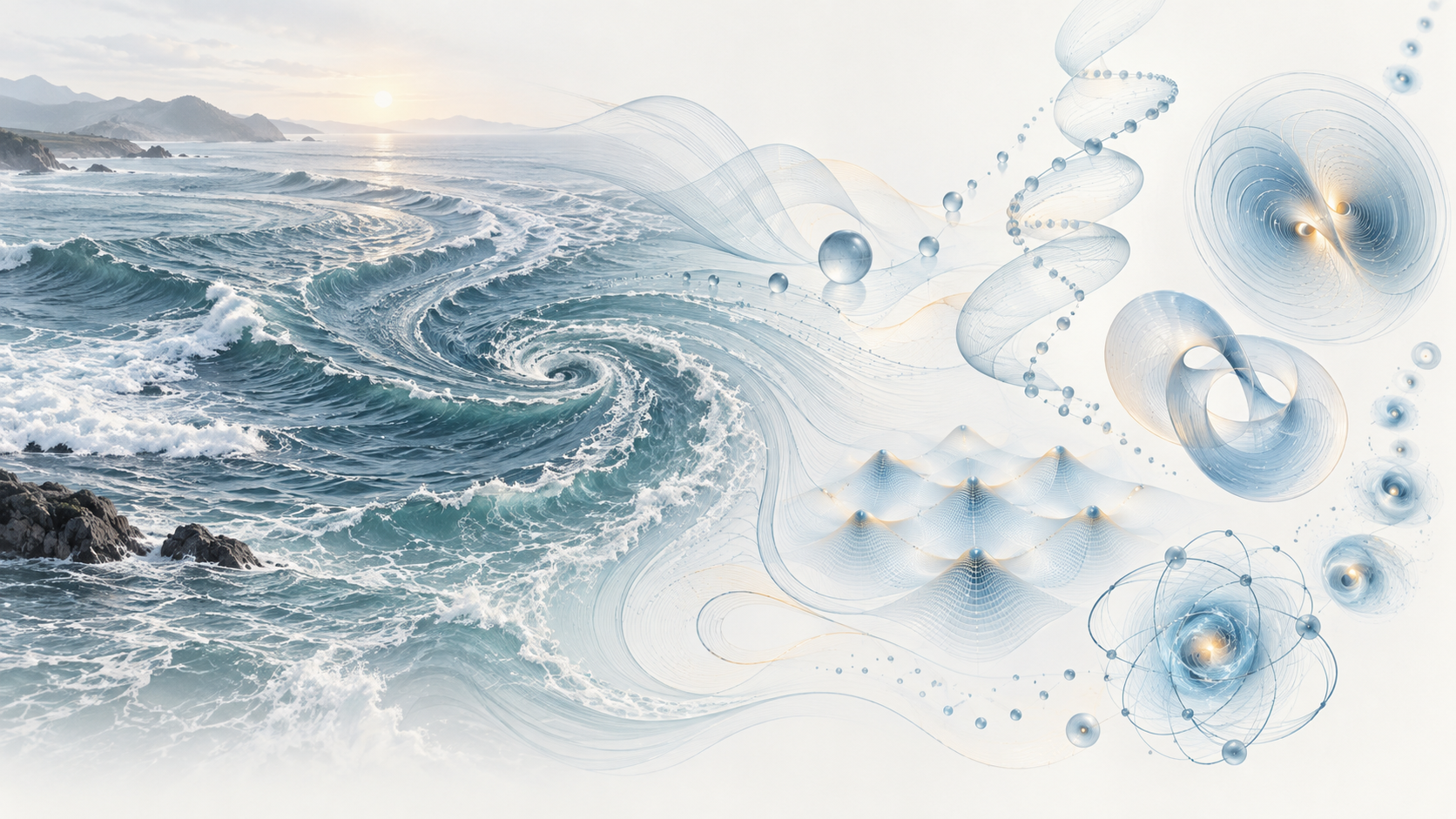
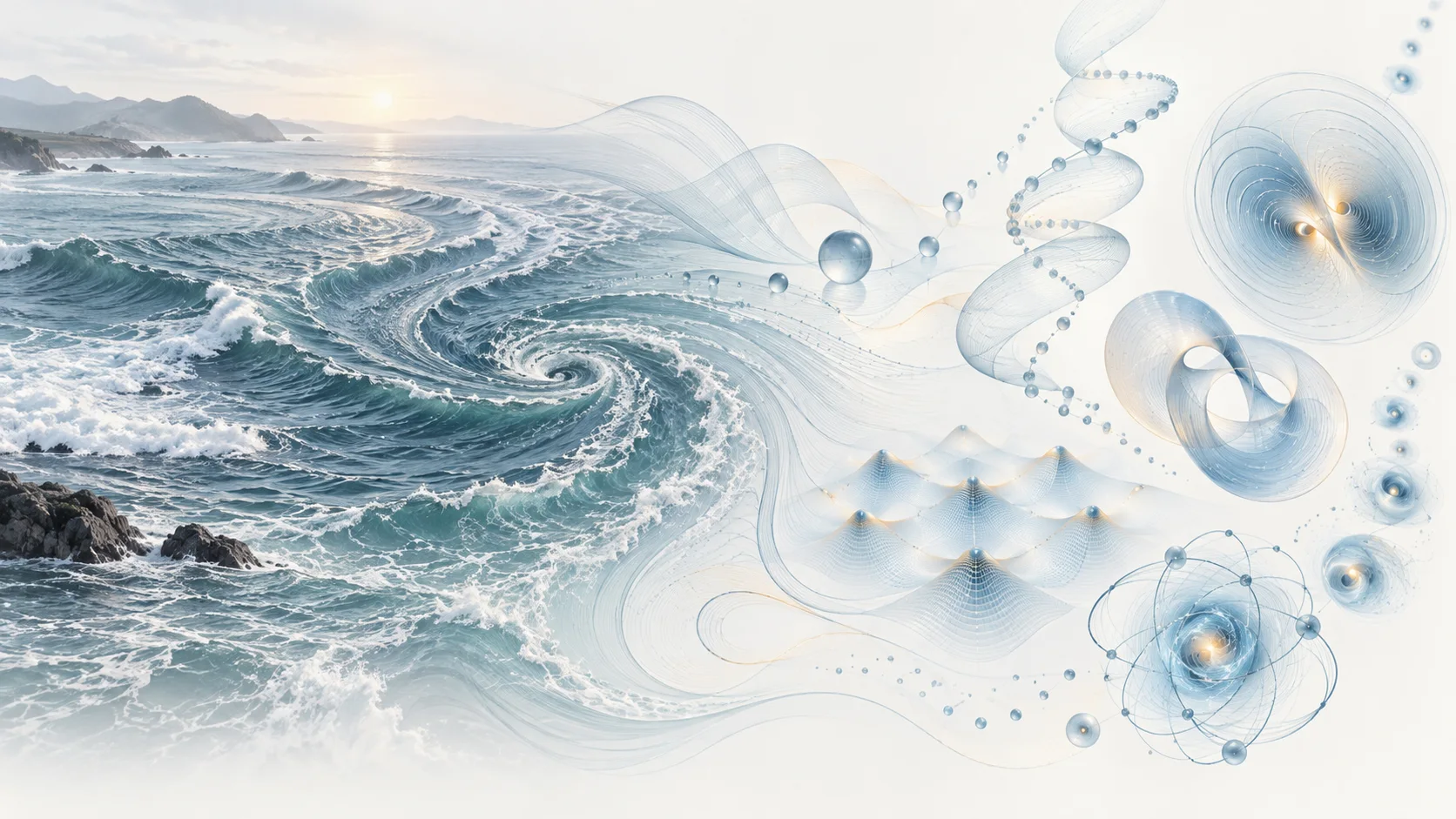
The original illustration was supplied by Xiaodan Wu and generated with ChatGPT on September 11, 2026. The optimized web copy and file-level provenance are recorded in the accompanying asset manifest.