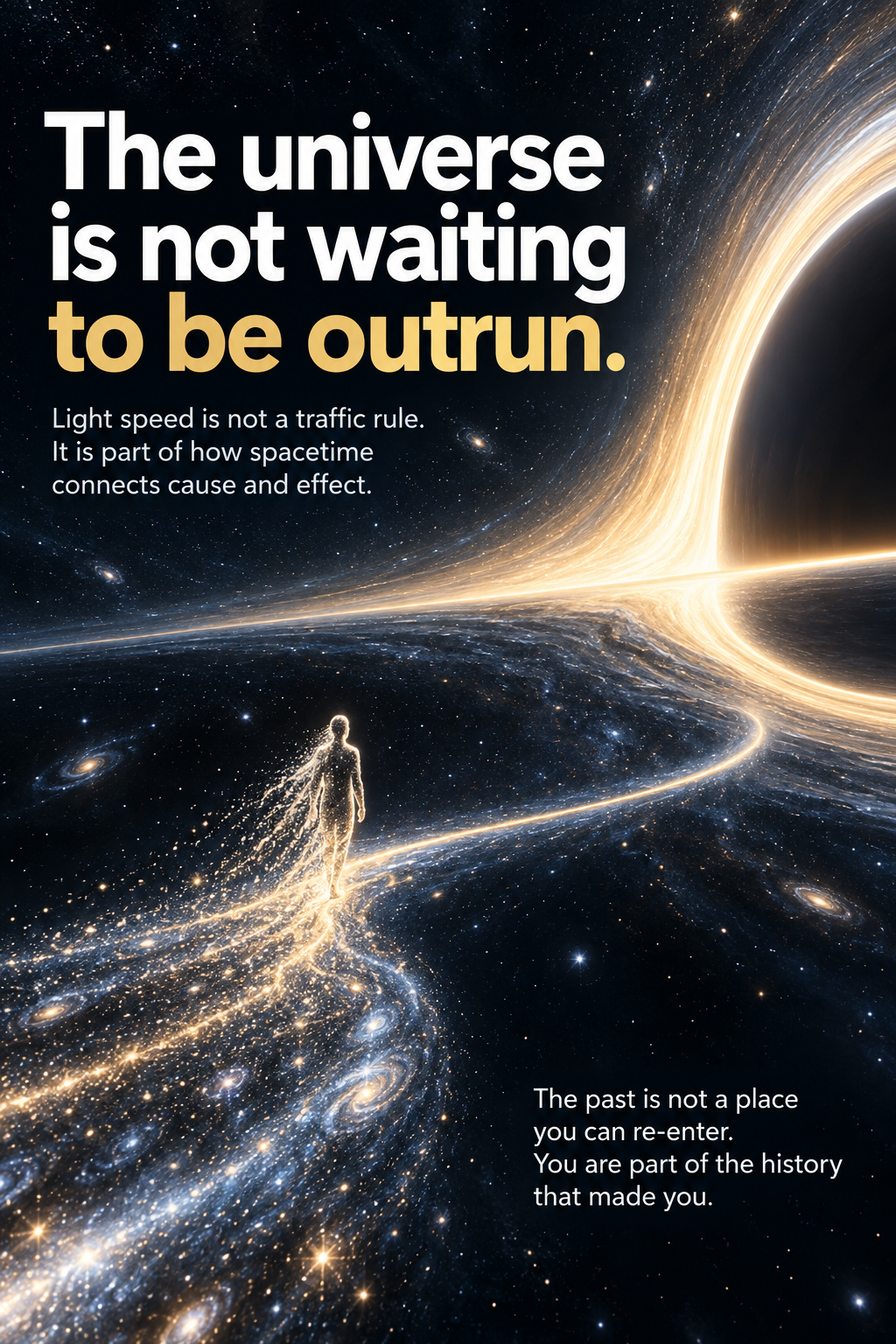
Scrolling through TikTok or YouTube, one often encounters fascinating claims about faster-than-light travel and time machines. In an age of artificial intelligence and rapid technological progress, many achievements that once seemed impossible are becoming ordinary. It is natural to imagine that a sufficiently advanced civilization might eventually overcome every limit we know.
Perhaps future civilizations will master fusion energy, cross interstellar distances, and develop technologies beyond our present imagination. But some limits may not be engineering problems. They may arise from the structure of physical reality itself.
The speed of light may be one of them.
The speed of light is not simply a speed limit
It is tempting to picture the speed of light as a cosmic version of a highway restriction. On that picture, a sufficiently powerful engine should eventually be able to break through it.
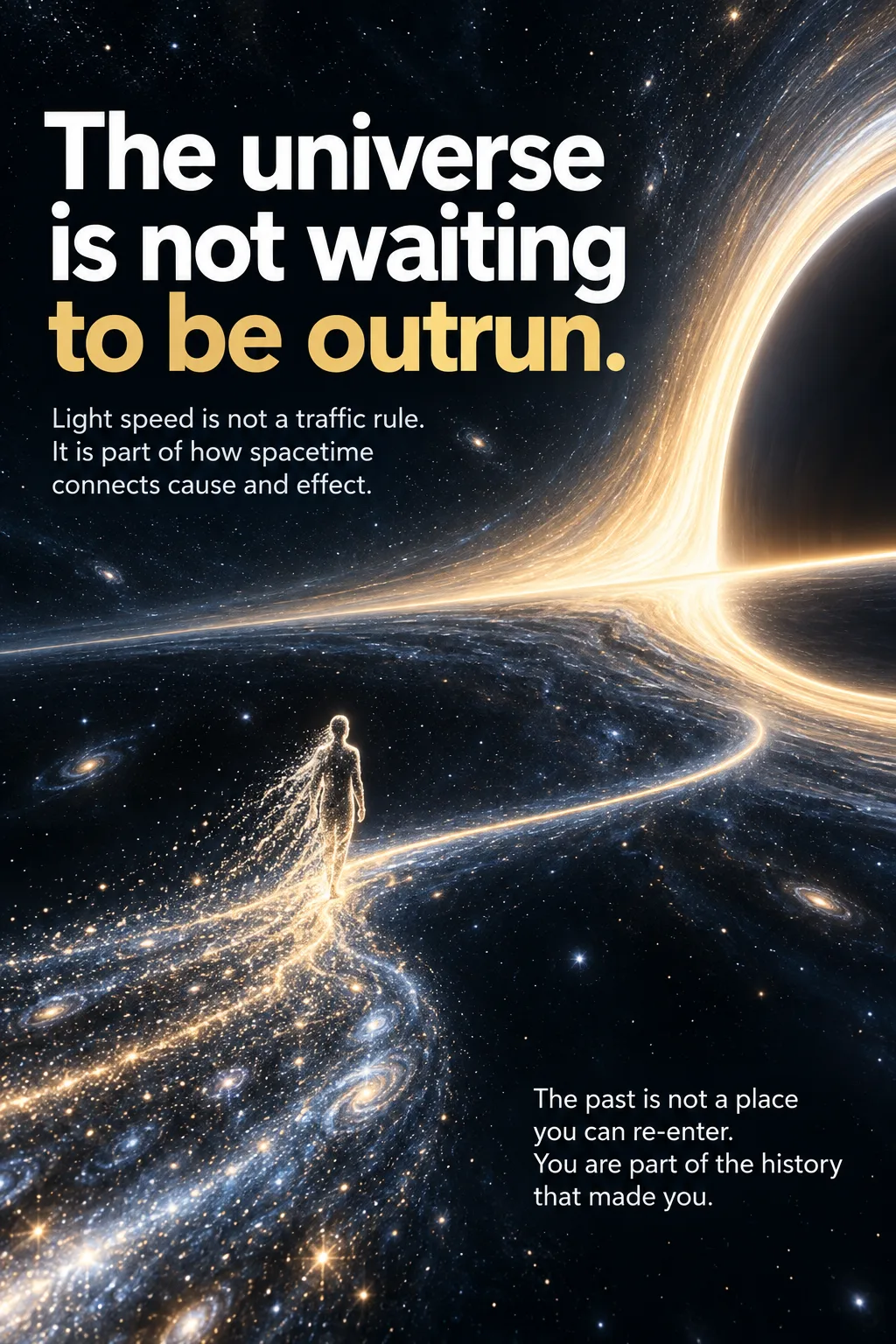
Special relativity says something deeper. The invariant speed c is not merely a property of light. It helps define the causal structure of spacetime: which events can influence one another and how information can propagate between them.
For a massive object, the relativistic factor is
γ=1−v2/c21.As its speed v approaches c, γ grows without bound. Accelerating an object with nonzero rest mass all the way to light speed would therefore require unbounded energy within special relativity. Light does not solve this problem by being a faster kind of massive traveler; massless radiation follows lightlike paths from the beginning.
This distinction matters. The barrier is not simply that our engines are weak. Relativity assigns massive and massless motion to different causal classes.
Ideas such as warp geometries and traversable wormholes attempt to change the geometry connecting distant events rather than locally accelerate a spacecraft through the light barrier. They are valuable theoretical probes. But their mathematical existence does not establish that the required physical conditions can be created, stabilized, or made compatible with quantum theory.
So the scientific question is not merely:
How can we build a faster engine?
It is also:
Does nature provide any physically realizable route that connects events faster than an ordinary light signal without destroying causal consistency?
No such route is presently known.
Faster-than-light signals threaten causal order
The difficulty is not only energetic. In special relativity, observers in relative motion can disagree about the time ordering of sufficiently separated events. If controllable information could propagate faster than light, there would be reference frames in which the signal was received before it was sent. Combining such signals could, in principle, produce a message to one’s own past.
That is why faster-than-light communication and time travel are not independent fantasies. They meet at causality.
The light cone is more than a boundary around fast motion. It separates events that can be connected by ordinary causal influence from events that cannot. Crossing that boundary would require physics that does not merely improve transportation, but reorganizes the ordering of cause and effect.
Why returning to the past may be a mistaken picture
Science fiction often treats time as a river. We are passengers carried downstream, and a sufficiently advanced machine might turn around and travel upstream.
That image is powerful, but it may be misleading. A physical object is not just a point that appears at one moment and then moves to another. Its present state embodies a continuous history: its structure, memories, records, and correlations all depend on earlier physical processes.
You are not simply a passenger placed inside time. Your present physical identity is partly constituted by the sequence that produced it.
From this perspective, returning to the past is not merely a problem of reaching a distant temporal address. It raises a more difficult question: how could a physical system step outside the causal history that constitutes its current state and then enter an earlier stage of that same history?
This philosophical argument is not, by itself, a proof that time travel is impossible. General relativity contains unusual solutions with closed timelike curves, including idealized rotating or multiply connected geometries. But a mathematical solution is not automatically a constructible machine. Such proposals face unresolved questions about formation, stability, energy conditions, quantum effects, and causal paradoxes.
The past may therefore be unlike a place preserved elsewhere in the universe. It may instead be the irreversible network of conditions and transformations from which the present emerged.
Spacetime may be part of the explanation
The deeper issue behind both faster-than-light travel and time travel is the nature of spacetime.
Is spacetime a fixed container in which matter moves? Or is it a physical structure whose geometry and causal order arise together with matter and interaction?
General relativity already rejects absolute, passive space and time: geometry responds to energy and momentum. Several research programs go further and ask whether spacetime itself could emerge from more fundamental relations or degrees of freedom.
My own research project, The Emergent Frame (TEF), explores a related possibility: massive matter may not merely occupy a pre-existing spacetime, but may participate in realizing the spatial and temporal relations through which physical processes become connected.
This remains a working research direction, not an established explanation of relativity. TEF has not derived the Lorentzian causal structure, the invariant speed c, or an arrow of time from first principles. Those are requirements that any viable emergent-spacetime framework must meet.
Still, the perspective changes the intuition. If spacetime is generated or realized through physical relations, then the speed of light and causal order may not be arbitrary regulations imposed on motion. They may express how physical connection itself is possible.
The earlier essay Can You See Yourself in a Mirror at the Speed of Light? approached the same boundary through proper time and observation. Here the emphasis is complementary: the light-speed limit is also a limit on causal rearrangement.
Limits can make physics more fascinating
Human imagination is drawn toward breaking boundaries. We dream of crossing the stars, controlling time, and acquiring abilities that seem almost godlike. That imagination is valuable. It drives exploration and enlarges the questions science is willing to ask.
But the deepest question is not always:
How do we escape the rules of the universe?
Sometimes it is:
Why does the universe have these rules?
Why is there an invariant causal speed? Why does time display an order? Why can records accumulate toward the future but not apparently be rewritten from it? Why do stable physical structures preserve histories at all?
Understanding why something cannot happen can reveal as much as discovering a new capability. A genuine physical limit is not a failure of imagination. It is evidence that reality possesses structure.
Perhaps the universe is not a completed room through which we are free to move in any direction. Perhaps it is an ongoing physical ordering of events, relations, and transformations.
We do not stand outside that ordering.
We are part of it.
Image record
The original lead illustration and original causality poster were supplied by Xiaodan Wu on September 19 and September 21, 2026, respectively. Optimized web copies and file-level provenance are recorded in the accompanying asset manifest.